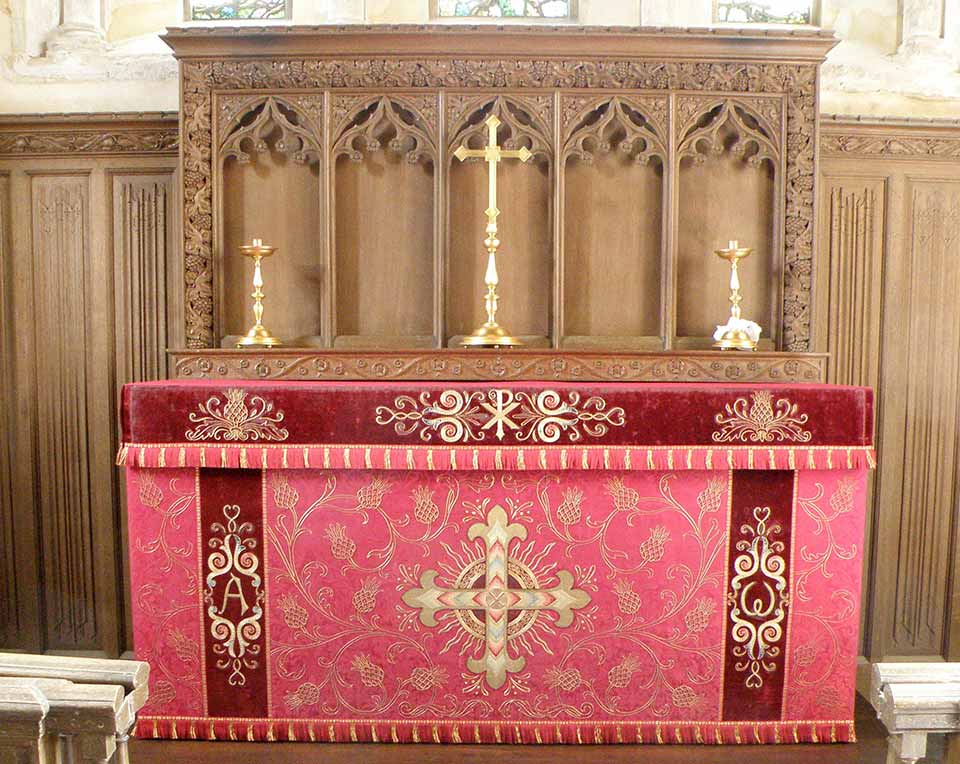
Altar Frontal, St Mary’s Church, Ickworth Conservation Trust
The Ickworth Church Conservation Trust (ICCT) was founded in 2006 by the Marquess of Bristol to conserve, maintain and repair the former church and churchyard of St Mary’s, Ickworth, Suffolk, for the benefit of the public. During 2012-13, after six years of research and fundraising, the Church was restored thanks to generous grants from the Heritage Lottery Fund, English Heritage and other donors.
In 2012, I was invited to tender for the conservation of the Altar frontal and was delighted to be awarded the project.
Condition prior to treatment

The Altar Frontal & Superfrontal were in the worst possible condition, the Church having been made redundant in 1984 and closed up since 1998. During this time it had been subject to extremely poor environmental conditions, a nightmare for the textiles, which had remained insitu throughout.
The condition was appalling. They were extremely dirty, with much surface dust and dirt and had suffered from the most severe pest infestation I have ever seen. The gold thread embroidery was hanging loose and tangled.
The Altar Frontal was designed and made for St Mary’s Church, in honour of the Bristol Family, given by Lady Mary Hervey in December 1914, being in use on Christmas day for the first time. The work was carried out by the Ladies Guild of Decorative Needlework in Sloane Street, London.
Made from a crimson-coloured silk damask, the Altar Frontal is embroidered with a design of trailing stems and pineapple motifs worked in laid and couched gold thread work. At the centre is a cross, worked in shaded Florentine stitch, over a sunburst of red velvet, outlined with gold thread.

To either side is a vertical panel of red silk velvet, embroidered with a scrolling design worked in shaded coloured silks and laid gold thread, each panel having an initial at its centre, to the left A, to the right W, the initials relating to the Bristol family.
The embroidery is professionally worked and of a very high standard. The lower edge of the Frontal is decorated with a fringe of crimson silk and gold-coloured metal thread. The Altar Frontal is mounted onto a wooden stretcher frame.
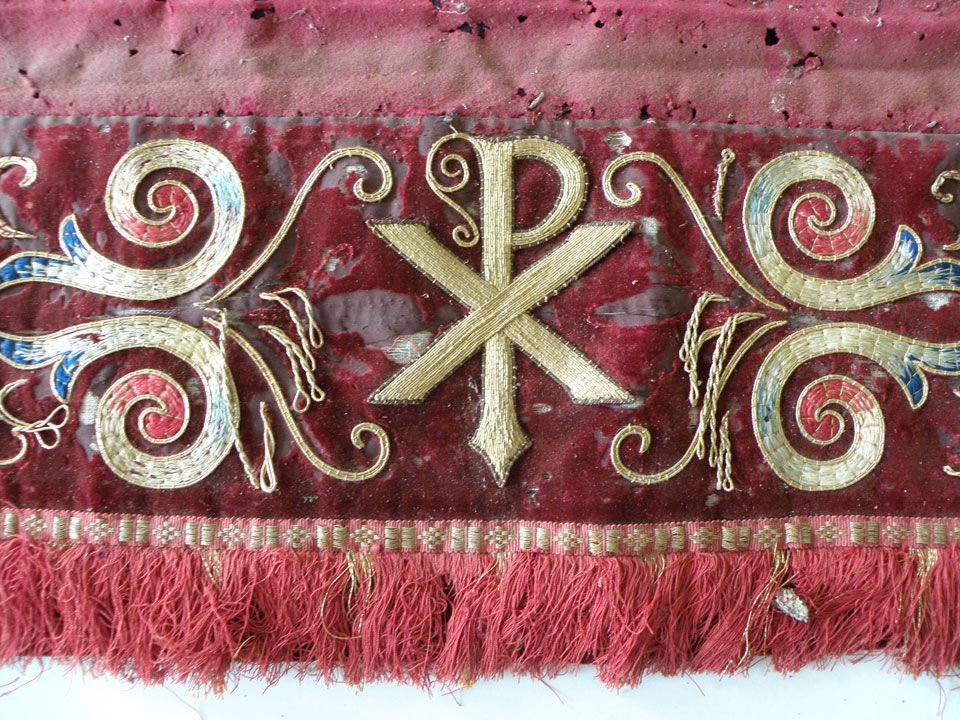
The Super Frontal has a front pelmet of red silk velvet embroidered with a central motif, a P over a cross, flanked by scroll work designs worked in coloured silks and gold thread.
To either side is a stylised pineapple, all worked in gold laid thread. The lower edge of the pelmet is decorated with a fringe of crimson silk and gold metal thread, matching the Altar Frontal. The two side pelmets are of the same red silk velvet edged with fringe. The top of the Super Frontal had a rectangular shaped central area of crimson wool fabric, designed to fit over the wooden altar table.
Treatment
The treatment was perhaps the most challenging I have faced. It started with a freezing treatment of both the stretcher mounted Altar Frontal and the Superfrontal at the facilities of Ipswich Museum before the objects could come anywhere near the studio.
As with many projects, the process required breaking everything down into stages so as not to become overwhelmed with the task. A progress report to the Trustees in January 2013 reminds me that the work required was far more extensive than anticipated.
The first task was to remove the Frontal from the stretcher, which involved the removal of hundreds of rusted metal tacks.
The wool lining was removed, documented and discarded – moths and insects had got under the silk Frontal to get to the tasty wool beneath. Days of surface cleaning by vacuuming ensued.
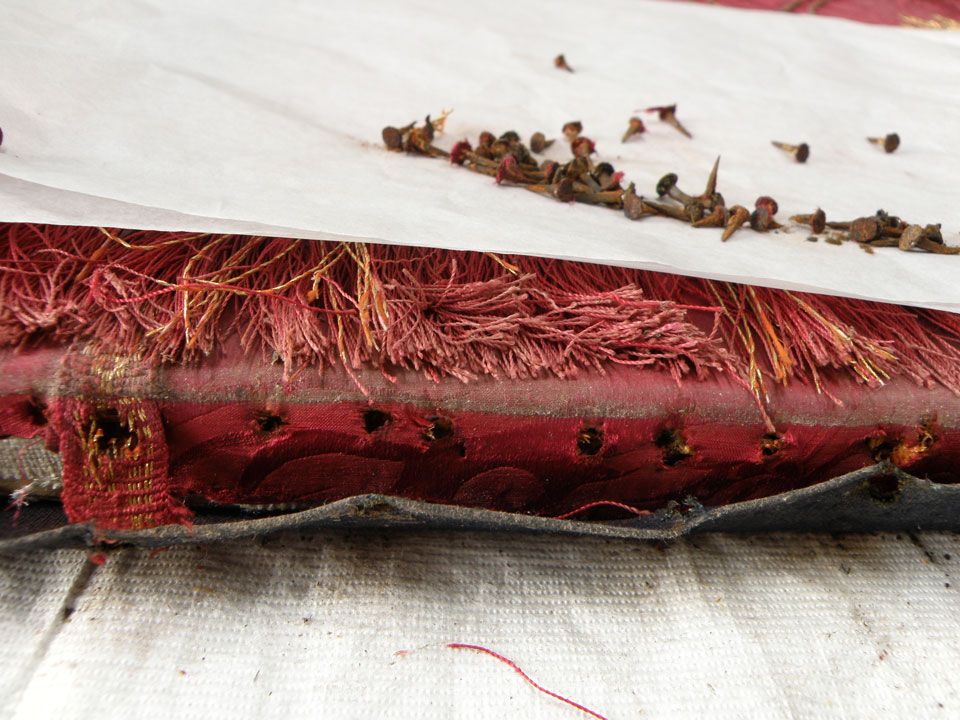
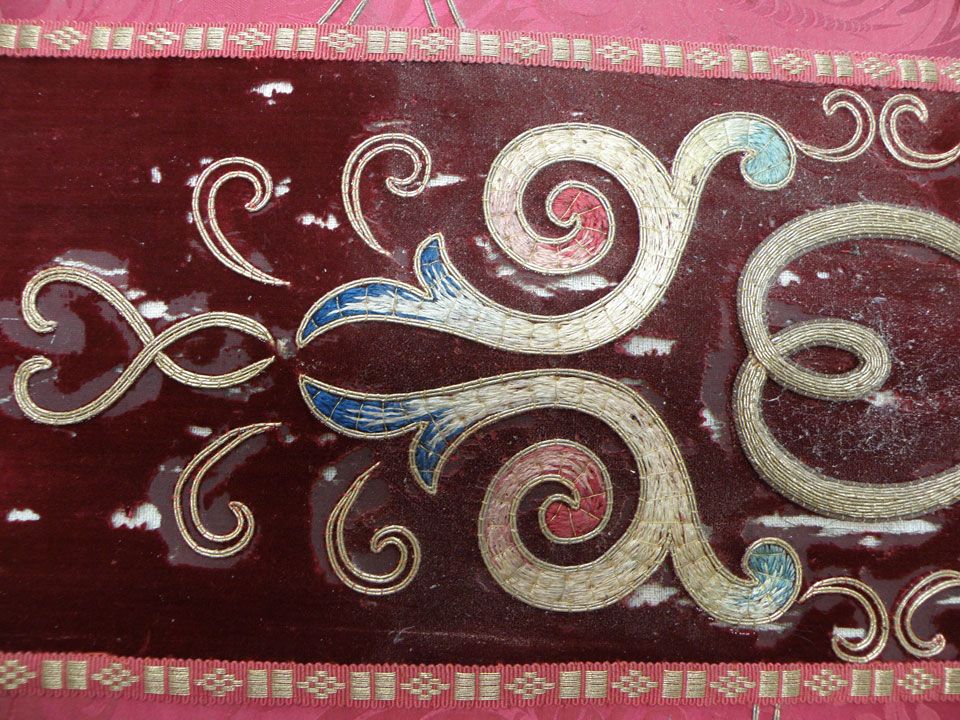
This was followed by humidification, both of which greatly improved the appearance of the panels of the Altar Frontal & Superfrontal.
The silk damask was applied onto a full backing support of dyed crimson silk and mounted onto an embroidery frame in order to carry out the stitching repairs to the embroidery.

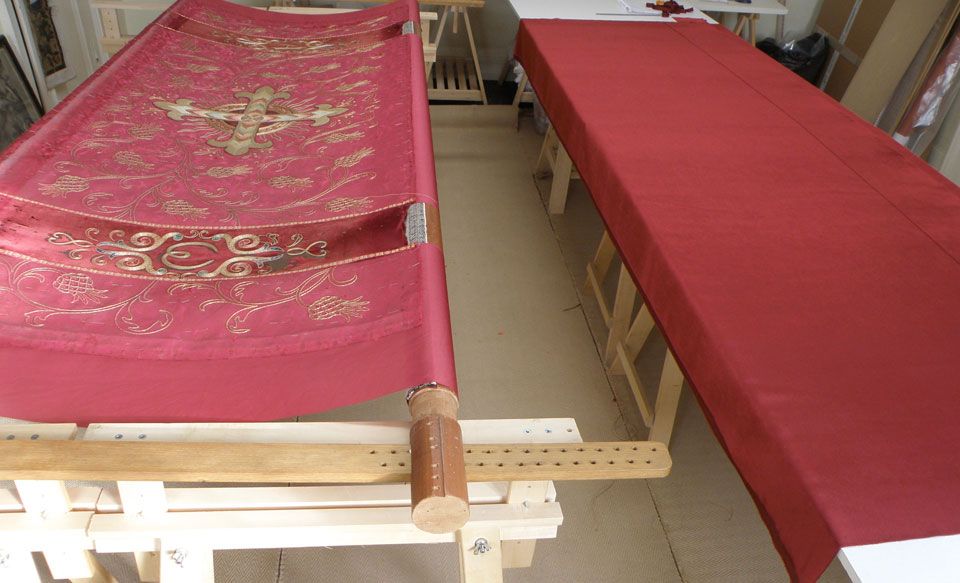
The many loose and tangled strands of gold-wrapped thread were repositioned and stitched down through the original damask and dyed support fabric.
After various trials, the damaged panels of dark red silk velvet were supported onto a new dark red velvet fabric, with stitching repairs being worked through both layers.
The condition of the original silk and metal thread braid and fringe was of great concern. It was very weak and much damage had been caused by the insect infestation. There were breaks, loss, distortion and areas of discolouration from dampness. It was decided to retire the original fringe and commission a replacement to match the original.
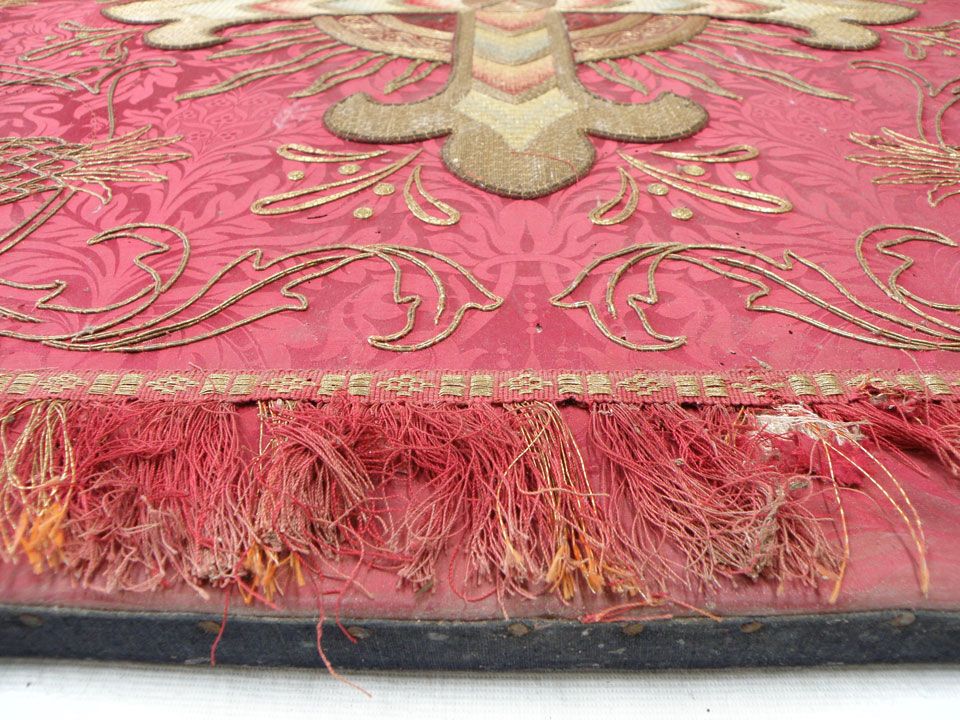
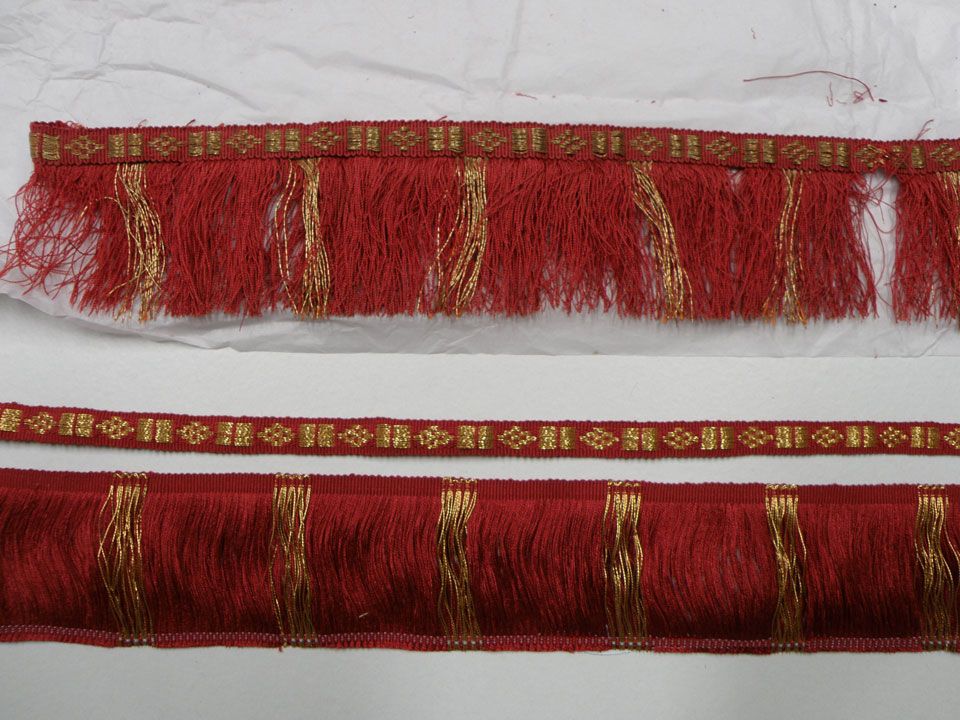
The original stretcher frame was reused. The stretcher was reduced slightly in height to allow for an ‘L’ shaped oak support to be made as a base for the stretcher to sit on. This will prevent the textile-covered stretcher from resting directly on the stone floor of the Church.
The embroidered silk velvet pelmet of the Superfrontal was in an extremely poor condition with many holes and splits and bald areas of velvet around the sections of embroidery. This was due to an adhesive being applied over the reverse to fix the embroidered threads in place, which had caused the velvet to deteriorate.
The plain crimson silk velvet fabric of the side pelmets was very thin, weak and in a very poor condition. In conservation we strive to retain all original elements of the object, however, in this situation where the textiles of the Altar Frontal would return to open display and not in a controlled environment, it was decide to retire the plain velvet side panels and replace them with a new crimson silk velvet.
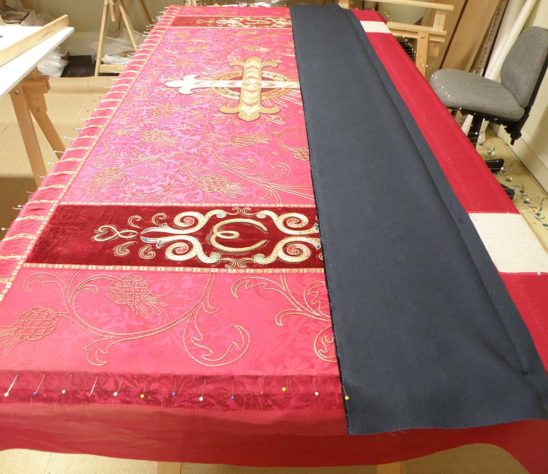
The crimson wool top of the Superfrontal had been ravaged by moth and insects and was in a tattered state. The fabric was replaced with a new crimson cotton repp fabric, which would not be attractive to moths.
A new replacement blue linen was used for the top of the Altar Frontal and for the lining.
The final ‘after’ results could not have been more of a contrast to what I found when I had first opened the door of the Church. Every stage had been a challenge. I was very pleased to have achieved such results and to have made such a difference to the condition and presentation.
It was a proud moment, when in June 2013, all those involved in the project came together to attend an opening Service of Blessing held by the Bishop of St Edmundsbury and Ipswich. The Altar Frontal was on display and in use for the ceremony and the church was reopened to the public.